Heavy Duty Gas Struts for Doors
High-Force Support Solutions for Large Industrial Doors
Large industrial doors require carefully engineered support systems to handle substantial moving loads, maintain stable positioning and provide controlled opening and closing movement.
Unlike lightweight access panels, heavy industrial doors often feature reinforced steel structures, thick panels, insulation layers and additional mechanical components. Their weight distribution and mounting geometry create significant forces on hinges, brackets and supporting frames.
Heavy duty gas struts help counterbalance these loads by generating controlled extension force through a precisely designed mounting arrangement.
TieYing manufactures heavy duty gas struts for large industrial doors, equipment access systems and demanding hinged panel applications. We provide standard and customized solutions for industrial equipment manufacturers, OEM brands, engineering contractors, wholesalers and distributors.
Our engineering approach considers more than the nominal door weight. We evaluate the centre of gravity, hinge position, opening angle, gas strut leverage, stroke requirements and mounting structure to develop a suitable configuration for each application.
Whether you need a standard heavy duty gas strut or a customized high-force solution, TieYing supports your project from initial specification review to manufacturing and bulk supply.
Looking for Heavy Duty Gas Struts for Your Door System?
Send us your door dimensions, technical drawings or existing gas strut specifications for an application review.
Heavy Duty Gas Strut Applications for Industrial Doors
1. Large Upward-Opening Industrial Doors
Large upward-opening industrial doors require sufficient lifting assistance to overcome the gravitational moment created by the moving panel.These doors are commonly designed with reinforced metal structures and substantial panel dimensions. As the door rotates around its hinge axis, the position of its centre of gravity changes, affecting the amount of supporting torque required throughout the opening movement.Heavy duty gas struts can assist the lifting movement and help support the door in its intended open position.Typical applications include:- Large industrial equipment access doors
- Heavy machinery enclosure doors
- Upward-opening maintenance panels
- Reinforced industrial inspection doors
- Large equipment housing covers
- Industrial service access openings
2. Heavy Machinery Service Doors
Large industrial machines often incorporate hinged access doors that provide entry to internal mechanical assemblies, drive systems and service components.These doors may be constructed from thick steel panels, reinforced frames and protective structures.A properly configured gas strut system can reduce the effort required to raise suitable service doors while helping maintain the required maintenance access clearance.Applications include:- CNC machinery service doors
- Metalworking equipment access panels
- Industrial processing machine doors
- Heavy production equipment enclosures
- Industrial inspection compartments
- Large mechanical equipment covers
3. Generator and Compressor Enclosure Doors
Generator sets and industrial compressors are frequently installed inside protective enclosures.These enclosures may incorporate large hinged access doors with reinforced steel panels, acoustic insulation, ventilation structures and weather-resistant sealing systems.The additional materials can significantly increase the moving mass of each door.Heavy duty gas struts can provide opening assistance for suitable hinged enclosure doors, making inspection and maintenance access easier.Typical applications include:- Industrial generator service doors
- Diesel generator enclosure access panels
- Compressor housing doors
- Power equipment maintenance compartments
- Acoustic enclosure access doors
- Industrial pump housing panels
4. Heavy Electrical and Power Equipment Doors
Large electrical equipment enclosures may use reinforced hinged doors to protect internal electrical assemblies and control components.When these doors are wide or fitted with additional protective structures, manual opening can become difficult.Heavy duty gas struts can assist suitable access doors while maintaining the clearance required for inspection and maintenance.Typical applications include:- Industrial power distribution cabinets
- Large electrical equipment enclosures
- Heavy switchgear access doors
- Industrial control system housings
- Power conversion equipment doors
- Reinforced electrical service panels
5. Heavy Outdoor Industrial Enclosure Doors
Outdoor industrial equipment requires protective housings designed to withstand environmental exposure.Access doors may incorporate weather seals, reinforced metal panels and additional protective components, resulting in increased weight and installation complexity.Gas strut configurations for these applications should be selected according to environmental conditions, including moisture, corrosion exposure, temperature variation and potential vibration.Typical applications include:- Outdoor industrial equipment doors
- Weather-resistant power enclosures
- Industrial utility access panels
- Outdoor generator housings
- Heavy-duty machinery service doors
- Industrial monitoring equipment enclosures
6. Large Industrial Maintenance Access Panels
Some industrial systems incorporate oversized hinged access panels that are opened during scheduled inspection, cleaning, repair or component replacement.Although these panels may not be operated continuously, their weight and dimensions can make manual handling difficult.A suitable gas strut arrangement can provide lifting assistance and help support the panel during maintenance operations.The complete system should include appropriate mechanical stops and independent safety support wherever personnel could be exposed to a falling or uncontrolled panel.Engineering Considerations for Heavy Duty Door Gas Struts
Door Weight and Centre of Gravity
The total moving mass determines the gravitational force acting on the door.However, the required gas strut force is not determined by mass alone.The distance between the hinge axis and the centre of gravity determines the gravitational moment generated by the door.A wide industrial door can create a larger rotational moment than a smaller door with the same mass because its centre of gravity may be positioned farther from the hinge.The calculation should include the complete moving assembly, including:- Main door panel
- Reinforcement structures
- Insulation materials
- Handles and locking components
- Viewing windows
- Attached accessories and hardware
Hinge Position and Rotational Torque
The hinge axis determines how the door rotates and how its gravitational moment changes during opening.For upward-opening doors with a horizontal hinge axis, the gravitational moment changes according to the door’s angular position.A suitable gas strut must generate an opposing moment sufficient to assist the door at critical positions throughout its intended movement.A configuration that provides adequate support when the door is fully open may still require excessive manual force during initial opening.For this reason, the complete opening arc should be evaluated before finalizing the gas strut specification.Gas Strut Mounting Geometry and Leverage
The position of the gas strut attachment points determines its mechanical advantage.The perpendicular distance from the hinge axis to the gas strut’s line of action represents its effective moment arm.A short moment arm requires greater gas strut force to generate the same supporting torque.Moving the mounting point farther from the hinge may improve leverage, but the resulting arrangement must also satisfy stroke, extended length, compressed length and clearance requirements.The objective is to achieve an effective balance between supporting force, installation space and the required door movement.Load Distribution for Wide Industrial Doors
Large industrial doors may experience uneven loading if supporting force is applied at only one location.For wide or flexible panels, two gas struts positioned symmetrically on opposite sides may provide a more balanced supporting arrangement.The final configuration should consider:- Door width and structural stiffness
- Centre-of-gravity position
- Force rating of each gas strut
- Mounting point symmetry
- Bracket and hinge strength
- Possible panel twisting or deformation
Mounting Bracket and Frame Strength
The gas strut transfers mechanical force through its end fittings and mounting brackets into the door panel and supporting frame.High-force applications can create significant local stresses at the attachment points.The mounting structure should therefore be designed to withstand the applied loads without deformation, loosening or excessive movement.Important considerations include bracket thickness, fastener size, weld quality, panel reinforcement and supporting frame stiffness.Operating Environment and External Loads
Industrial doors may operate under temperature variation, equipment vibration, moisture, dust and external mechanical loads.Outdoor installations may also experience wind pressure, which can create additional torque on an open door.These conditions should be evaluated separately from the door’s static gravitational load.Gas struts should not be treated as substitutes for mechanical latches, wind restraints or independent safety supports.Heavy Duty Door Gas Strut Force Calculation
- F = Required force per gas strut (Newtons)
- W = Door weight expressed as force (door mass in kg × 9.81 = N)
- d = Horizontal distance from the hinge axis to the door’s centre-of-gravity force line (mm)
- n = Number of gas struts sharing the load
- h = Perpendicular distance from the hinge axis to the gas strut’s centreline (mm)
- SF = Safety factor, typically 1.1–1.25 for a preliminary hold-open estimate
Understanding the Calculation
The formula balances the gravitational moment generated by the door against the supporting moment produced by the gas struts.The value of d represents the effective horizontal moment arm of the door’s weight at the selected opening position.The value of h represents the shortest perpendicular distance from the hinge axis to the gas strut’s line of action.Both distances must be measured at the same door position and expressed in the same units.Practical Calculation Example
Consider an upward-opening industrial access door with the following specifications:| Parameter | Value |
|---|---|
| Door mass | 60 kg |
| Door weight force (W) | 588.6 N |
| Centre-of-gravity distance (d) | 450 mm |
| Number of gas struts (n) | 2 |
| Gas strut moment arm (h) | 160 mm |
| Safety factor (SF) | 1.15 |
Calculation:
F = (588.6 × 450) / (2 × 160) × 1.15
F ≈ 952 N per gas strut
The preliminary estimated requirement is approximately 952 N per gas strut at the assessed door position.
This is an engineering starting point, not an automatic final product specification. The selected gas strut must also be checked against its force progression, mounting dimensions, operating temperature and complete movement range.
Why the Full Opening Movement Must Be Checked
Gas strut geometry changes as the door opens and closes.
The effective moment arm, strut length and internal gas pressure can vary throughout the movement.
Therefore, a single static calculation cannot confirm that the door will operate correctly at every position.
A complete assessment should examine:
- Initial opening force
- Supporting force at intermediate positions
- Maximum opening position
- Closing effort
- Gas strut travel and mounting clearance
- Potential over-centre movement
- Hinge and mounting bracket loading
For side-hinged doors rotating around a vertical axis, the gravitational moment calculation above does not apply directly in the same way. Their opening and closing assistance must be evaluated according to the actual hinge axis and mechanism.
Engineering Note: The safety factor is a preliminary design allowance, not a substitute for a mechanical locking system or independent personnel safety support.
Heavy Duty Door Gas Strut Configurations
The number and arrangement of gas struts should be determined according to the door’s dimensions, structural stiffness, weight distribution and required operating performance.
Single Gas Strut Arrangement
A single gas strut may be suitable for certain narrow industrial doors or access panels with a rigid supporting structure.The mounting arrangement must be designed to avoid excessive twisting or uneven loading.The hinge and door frame must also be capable of accommodating the resulting forces.Dual Gas Strut Arrangement
Two gas struts are commonly considered for wide or heavy upward-opening doors.They are generally installed symmetrically on opposite sides of the panel to provide balanced lifting assistance.The arrangement should use matched force ratings and consistent mounting dimensions.A properly designed dual-strut system can help reduce uneven panel loading and improve the stability of the opening movement.Multiple Gas Strut Arrangement
Some large industrial door systems may require more than two supporting units.Multiple gas struts must be positioned according to the actual load distribution and structural requirements.Adding more struts does not automatically produce a better result. The force contribution, mounting geometry and panel stiffness must be evaluated together.Heavy Duty Door Gas Struts – Typical Technical Specifications
TieYing supports heavy duty door gas strut configurations for industrial applications requiring higher supporting forces and reinforced product construction.
The following table provides typical reference specifications for common heavy-duty door configurations.
| Technical Parameter | Typical Specification |
|---|---|
| Product Application | Large Industrial Doors and Heavy Hinged Access Panels |
| Typical Force Range | 500–2,500 N |
| Special Force Requirements | Higher forces available through custom engineering |
| Cylinder Outer Diameter | 28 mm, 35 mm, 40 mm |
| Piston Rod Diameter | 12 mm, 14 mm, 16 mm |
| Typical Stroke Range | 100–800 mm |
| Extended Length | Application-dependent; customized to mounting dimensions |
| Cylinder Material | Seamless Carbon Steel |
| Piston Rod Material | Hardened Steel with Hard Chrome or Nitride Finish |
| Optional Materials | Stainless Steel 304 / 316 |
| Working Temperature | Typically -30°C to +80°C, depending on configuration |
| Cycle Life | Product-dependent; selected configurations tested up to 200,000 cycles |
| End Fittings | Ball Joints, Eyelets, Clevis Forks, Threaded Connections |
| Surface Treatment | Zinc Plating, Black Finish and Other Protective Coatings |
| Special Functions | Locking, Customized Damping and Special Force Configurations |
| Customization | Force, Stroke, Length, Diameter, Material and Mounting Connections |
Important: These are typical reference specifications, not a guarantee that every force, diameter and stroke combination is available together. Actual specifications depend on the selected product series and application requirements.
For higher loads, non-standard dimensions or special operating conditions, TieYing can review customized configurations according to your door design.Standard and Custom Heavy Duty Door Gas Struts
Standard Heavy Duty Door Gas Struts
Standard configurations are suitable for applications using commonly available force ratings, dimensions and mounting connections.Typical characteristics include:- Common heavy-duty force ranges
- Established cylinder and rod dimensions
- Regular stroke options
- Standard extended lengths
- Conventional mounting fittings
- Established material and surface finish options
Custom Heavy Duty Door Gas Struts
When standard configurations cannot meet the required load, installation space or operating performance, TieYing supports customized manufacturing.Custom options may include:Customized Force Ratings
Gas strut force can be specified according to the door’s mass, centre of gravity, mounting geometry and required operating effort.Non-Standard Stroke Lengths
Customized stroke dimensions can accommodate unusual door movement and restricted installation spaces.Customized Extended and Compressed Lengths
Overall dimensions can be developed according to the available mounting centres in the closed and open positions.Cylinder and Piston Rod Dimensions
Different cylinder and rod configurations can be evaluated for higher force requirements and specific mechanical conditions.Customized End Fittings
Ball joints, eyelets, clevis connections, threaded fittings and application-specific mounting brackets can be considered.Material and Surface Finish
Carbon steel, stainless steel and suitable protective surface treatments can be selected according to the operating environment.Special Performance Requirements
Where necessary, customized damping characteristics, locking functions and temperature-related requirements can be reviewed.TieYing works with customer drawings, samples, technical specifications and application photographs to evaluate manufacturing feasibility before confirming the final design.Critical Installation Rules for Heavy Duty Door Gas Struts
Correct installation is essential for obtaining the intended force performance and service life.
The following mounting principles should be considered when designing or installing heavy duty door gas struts.1. Piston Rod Orientation
For conventional compression-type gas struts, the piston rod should generally face downward when the door is in its closed or resting position, provided this is consistent with the manufacturer’s installation instructions.This orientation helps maintain lubrication around the rod seal and supports the intended end-of-stroke damping characteristics.Special gas strut designs may require different mounting orientations.2. Over-Center Geometry
For door mechanisms designed with an over-center arrangement, the gas strut line of action should pass slightly beyond the specified hinge reference position when the door is closed.This changes the direction of the supporting torque and can help the mechanism remain in its closed position without automatically pushing the door open.The exact geometry must be designed and validated for the specific door mechanism. Over-center positioning should not be applied universally to every industrial door.3. Reserve Stroke
The gas strut should not reach its fully compressed mechanical limit before the door reaches its intended closed position.Leave approximately 10 mm of unused stroke at full compression as a preliminary design allowance, subject to the product manufacturer’s dimensional requirements.This helps prevent the gas strut from bottoming out and transferring impact loads into the piston, brackets or door structure.Mechanical stops should define the door’s permitted travel.4. Avoid Side Loading
Gas struts are designed primarily to transmit force along their longitudinal axis.Misaligned mounting points or restricted pivot movement can introduce unwanted side loads.Side loading may increase friction, damage the piston rod and accelerate seal wear.Ensure that both mounting connections are properly aligned and can accommodate the required angular movement throughout the complete door travel.5. Match Gas Struts in Paired Installations
When two gas struts are used to support the same door, both units should have matched force ratings and compatible dimensions.Unequal force output can create uneven lifting assistance, panel twisting and additional stress on the mounting structure.If one gas strut in a matched pair has lost force or failed, replacing both units together is generally recommended to restore balanced performance.6. Secure the Door Before Servicing
Always provide independent mechanical support for a heavy door before removing, replacing or installing gas struts.Never rely on a single gas strut or an unsecured door panel to support its own weight during maintenance.Use a suitable mechanical prop or safety restraint to prevent unexpected movement.Additional Installation Considerations
- Confirm that the gas strut does not interfere with internal equipment.
- Check the fully open and fully closed mounting dimensions.
- Protect the piston rod from impact, scratches and contamination.
- Use suitable fasteners and reinforced mounting brackets.
- Confirm that the door hinges can withstand the applied forces.
- Test the complete opening and closing movement before placing the equipment into service.
TieYing Heavy Duty Gas Strut Manufacturing Capabilities
TieYing is a gas spring manufacturer based in Guangzhou, China, providing standard and customized gas spring solutions for industrial customers, OEM manufacturers, wholesalers and distributors.
With more than 20 years of manufacturing experience, we support projects requiring application-specific dimensions, force ratings, mounting connections and performance characteristics.Application-Based Product Development
We review the actual door construction, mounting dimensions and intended movement before recommending a suitable gas strut configuration.Customer drawings, existing samples and application photographs can be used as the starting point for technical discussions.Custom Force and Dimensional Manufacturing
Our customization capabilities include force ratings, stroke lengths, extended lengths, compressed lengths, cylinder dimensions, piston rod dimensions and end fittings.This allows us to support both established product configurations and specialized industrial door requirements.OEM and ODM Production
TieYing works with industrial equipment manufacturers, product brands and distributors requiring gas spring components for their own products and systems.Project specifications can be established according to approved drawings, samples and manufacturing requirements.Material and Surface Treatment Options
Different industrial environments require different material and protective finish selections.Depending on the project, carbon steel and stainless steel 304 or 316 configurations can be evaluated.Quality Inspection and Product Testing
Our manufacturing quality process includes dimensional inspection, force verification, leakage testing and product performance evaluation according to applicable product specifications.Testing requirements can be established according to the intended application and agreed product performance criteria.TieYing Factory Photos Show
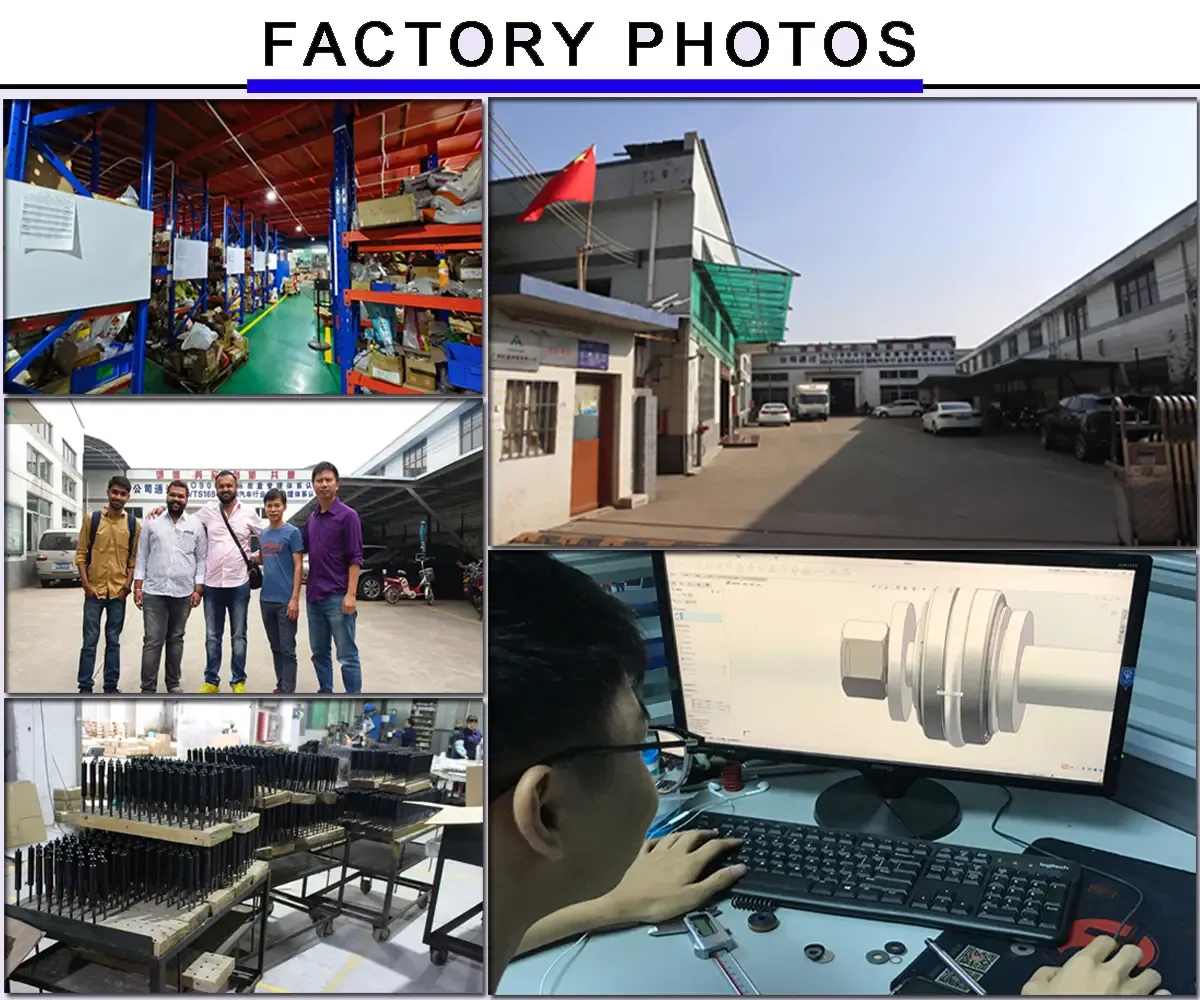
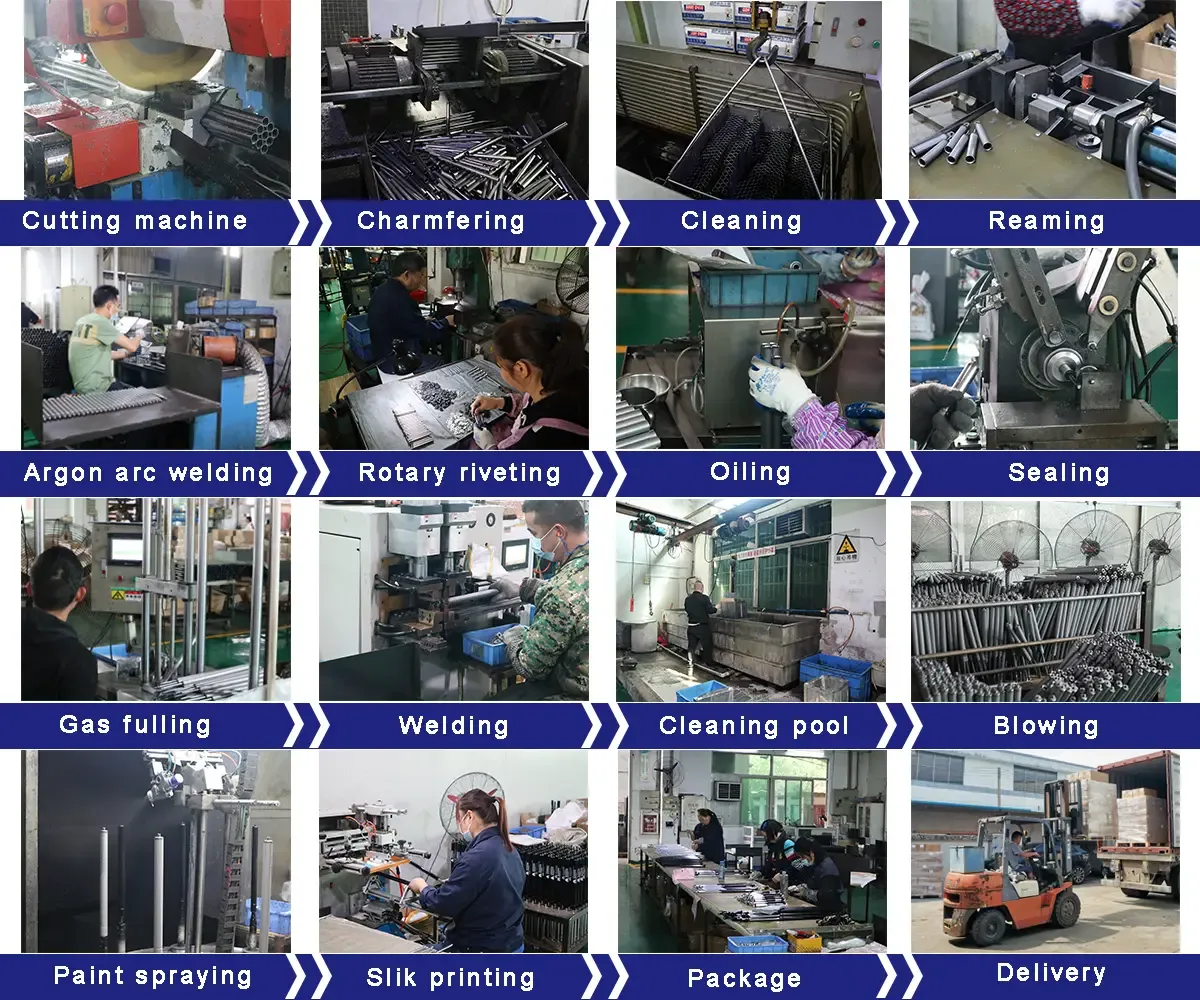
TieYing Factory Gas Springs Production Flow

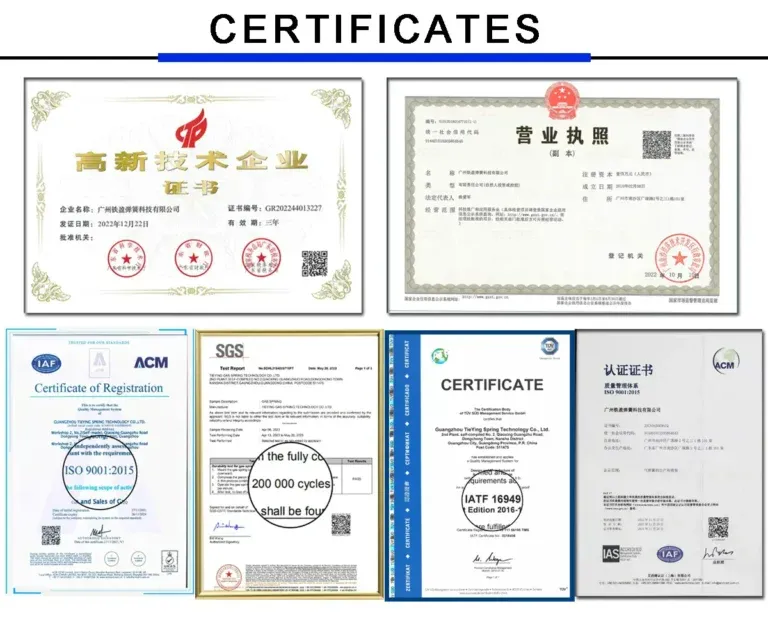
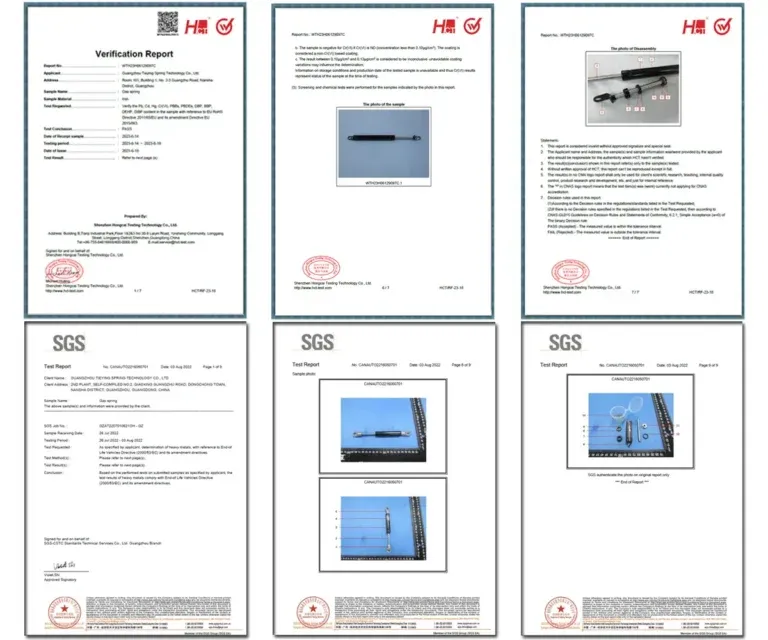
TieYing Factory Certifications & Quality Assurance
Factory Management System Certifications:
ISO 9001 – Quality Management System;IATF 16949 – Automotive Quality Management System
Product Testing & Compliance:
SGS – 200,000-Cycle Durability Test;RoHS – Restriction of Hazardous Substances
TieYing Factory Video Verified by SGS
Competitive Advantages of TieYing Gas Springs
| Item | TieYing Gas Springs | Standard Gas Springs (Other Supplier) |
|---|---|---|
| Certificate | SGS 200000 Cycles Durability Test, ROHS, T16949, IS09001 | Maybe just ISO9001 |
| Material | Top seamless steel (Full inspection by Professional testing equipment) | Maybe steel |
| Oil | Anti-wear hydraulic oil from Garmany | Maybe Semi-Synthetic |
| Piston Roughness | Up to Ra 0.696um | Maybe Ra 0.4um |
| Gas spring resistance | 100°C~-40°C | Maybe 60°C |
| Gas | 99.99% nitrogen | Maybe oxygen / Impure nitrogen |
| Uselife | 80,000-200,000 cycles with SGS test report | Maybe 50,000 cycles |
| Salt spray testing | Up to 96 hours | Maybe up to 12 hours |
| Inspection | All procedure sampling inspect, complete inspect before delivery | Maybe sampling inspection |
| Defective product | Re-produce new, If reach 10%, 100% items re-produce new | Maybe Repair |
Information Required for a Heavy Duty Door Gas Strut Quotation
To evaluate your application and recommend a suitable gas strut configuration, our engineering team needs several important measurements.
| Required Information | Description |
|---|---|
| Door Weight | Total weight of the complete moving door assembly |
| Door Width | Overall horizontal panel dimension |
| Door Height | Overall vertical panel dimension |
| Door Thickness | Panel thickness and structural construction |
| Hinge Position | Location and orientation of the hinge axis |
| Centre of Gravity | Distance from the hinge to the door's centre of gravity |
| Opening Angle | Required maximum opening position |
| Gas Strut Quantity | Number of supporting units |
| Mounting Points | Frame-side and door-side attachment coordinates |
| Installation Space | Available space in closed and open positions |
| Operating Environment | Indoor, outdoor, humid, dusty or corrosive conditions |
| Operating Frequency | Estimated opening and closing cycles |
| Order Quantity | Prototype quantity and expected production volume |
Existing Gas Strut Replacement Projects
If you are replacing an existing component, please also provide:- Existing gas strut force rating
- Extended length
- Compressed length
- Stroke length
- Cylinder diameter
- Piston rod diameter
- End fitting dimensions
- Existing product model or part number
Frequently Asked Questions About Heavy Duty Gas Struts for Doors
What are heavy duty gas struts for doors used for?
Heavy duty gas struts are used to provide lifting assistance and supporting force for suitable large hinged industrial doors and access panels.
They are commonly applied to machinery service doors, generator enclosure doors, heavy equipment housings and industrial maintenance access systems.
Their purpose is to reduce manual operating effort and support the door through its intended movement.
How much force is required for a heavy industrial door gas strut?
The required force depends on the complete door mass, centre-of-gravity position, hinge axis, gas strut mounting geometry and number of supporting units.
A simplified moment-balance calculation can provide an initial estimate.
However, the final force specification should be checked at critical door positions and against the actual gas strut force characteristics.
What is the typical force range for heavy duty door gas struts?
Common heavy-duty door configurations may use force ratings in the range of approximately 500–2,500 N per unit.
Higher-force configurations can be considered for specialized industrial applications.
The actual requirement must be determined by the door’s mechanical design rather than by selecting a force rating based only on its weight.
Should I use one or two gas struts for a heavy door?
The number depends on door width, weight distribution, structural stiffness and mounting geometry.
Two gas struts installed symmetrically can help distribute supporting forces across a wide door.
However, the final arrangement should be evaluated according to the complete mechanical assembly.
Can TieYing manufacture custom heavy duty door gas struts?
Yes. TieYing supports customized gas strut manufacturing for industrial door systems and OEM projects.
Customization can include force ratings, stroke lengths, extended lengths, cylinder and piston rod dimensions, mounting connections, materials and special performance requirements.
Can heavy duty gas struts keep an industrial door open?
A correctly selected gas strut can provide supporting force to help maintain a suitable door in its intended open position.
However, a conventional gas strut is not a positive mechanical safety lock.
Where personnel may work underneath an open door, an independent mechanical support or locking provision should be incorporated according to the equipment safety requirements.
What materials are available for outdoor industrial door applications?
Carbon steel with suitable protective surface treatments may be appropriate for protected industrial installations.
For applications exposed to moisture, humidity or corrosive conditions, stainless steel 304 or 316 options may be considered.
The final selection depends on the actual environmental exposure and required corrosion resistance.
How long do heavy duty door gas struts last?
Service life depends on product construction, seal design, force rating, stroke, temperature, operating frequency and actual application loads.
Different gas strut series can have different cycle-life ratings.
Selected TieYing configurations have undergone SGS 200,000-cycle durability testing. Specific test results should be checked against the applicable model and test report.
Can I replace only one gas strut in a dual-strut door system?
Although replacing one unit may be technically possible, replacing both matched gas struts together is generally recommended when one has lost force or failed.
Using one worn unit and one new unit can result in unequal supporting forces and unbalanced door movement.
What information should I provide to request a quotation?
For an initial assessment, provide the complete door weight, dimensions, hinge position, centre-of-gravity distance, opening angle, mounting measurements, required quantity and operating environment.
A technical drawing or photographs of the installed door mechanism are particularly helpful.
Request Custom Heavy Duty Gas Struts for Doors from TieYing
A heavy industrial door requires more than a high-force gas strut. It requires a supporting component designed around the door’s actual mechanical geometry, load distribution and operating conditions.
TieYing works with industrial equipment manufacturers, OEM brands, engineering teams and distributors to develop heavy duty gas strut configurations for demanding door applications.
Whether you need standard heavy-duty configurations, specialized force ratings or fully customized gas struts, our team is ready to review your project requirements.
Send Us Your Door Drawings, Measurements or Existing Gas Strut Specifications.
Let TieYing help you develop a suitable gas strut solution for your industrial door system.
TieYing – Your Gas Spring Manufacturing Partner
Custom Gas Struts | Heavy Duty Solutions | OEM & ODM Manufacturing