Canopy Gas Struts for Awnings, Truck Canopies & Marine Tops
Factory-direct canopy gas struts and awning gas springs, custom-engineered to lift, hold and damp outdoor canopies against wind, weather and daily use.
- 23+ yrs OEM & custom gas spring manufacturing
- IATF 16949 certified · SGS 200,000-cycle verified
- 60–600 N outdoor canopy force range (custom up to 1,200 N)
- Stainless steel 304/316 & nitro-carburized rods for coastal use
- OEM / ODM · private label · global bulk supply
What Are Canopy Gas Struts?
A canopy gas strut is a sealed, nitrogen-pressurized cylinder that lifts, supports and controls the movement of a canopy structure — the fabric or panel assembly above a patio, truck bed, boat deck or storefront. Unlike rigid props, manual poles or friction hinges, a gas strut releases stored gas pressure gradually: the canopy rises smoothly, holds firmly at the chosen opening angle, and lowers under control instead of slamming.
- Compressed nitrogen – Pre-charged force balances the canopy’s weight at your mounting geometry, so the fabric stays taut and the frame stays loaded correctly.
- Sealed rod & seal system – Precision seals deliver consistent force through the full stroke and require zero maintenance.
- Damping & locking options – Integrated damping controls deployment speed; optional locking mechanisms hold the canopy at fixed positions against wind or gravity.
Why Canopies Need Properly Engineered Gas Struts?
Outdoor canopies fail in predictable ways when they rely on hinges, poles or undersized struts:
- Sagging fabric & frame – Without adequate support, fabric pools and crossbars droop, trapping water and stressing the frame.
- Flapping and lift-off in wind – A gust can shake the canopy violently or lift it past its safe angle; the damage shows first at hinges and fabric seams.
- Hard, unsafe operation – Heavy or high-mounted canopies are difficult and risky to open and close manually.
- Premature component wear – Repeated impact and overload shorten the life of hinges, brackets, springs and the fabric itself.
A correctly specified canopy gas spring system:
- Supports the full canopy weight and holds the open position hands-free
- Provides controlled damping so deployment is smooth in any weather
- Uses twin struts, symmetrically mounted, to prevent frame twisting on wide spans
- Extends the service life of hinges, frames and fabrics
Canopy Applications We Serve
Patio & Garden Awnings
Retractable patio awnings, fixed pergola shades and garden gazebo canopies rely on compact, low-profile gas struts that disappear into the structure when closed.
Applications: Retractable patio awnings · Pergola and garden shade canopies · Gazebo and veranda canopies
Benefits: Clean, unobtrusive installation · Smooth one-hand deployment · UV-stable finishes for sun-exposed frames
Retractable & Cassette Awnings
Cassette and crank-operated awnings need positive position holding across their travel range.
Applications: Wall-mounted retractable awnings · Cassette / full-cassette awnings · Crank or motor-assisted awning arms
Benefits: Locking gas struts hold the awning at set positions · Damping prevents uncontrolled extension in gusts · High cycle life for seasonal daily use
Truck Canopies & Camper Shells
Pickup truck toppers and camper shells use struts on rear hatches, side windows and tilt-up tonneau covers.
Applications: Truck canopy rear hatch windows · Camper shell side windows · Tonneau tilt covers and service doors
Benefits: Compact bodies for tight frames · Anti-vibration performance on the road · 150–350 N ratings matched to glass and frame weight
Marine Bimini Tops & Boat Canopies
Salt air, spray and direct sun make marine canopies the toughest material case.
Applications: Bimini tops and T-tops · Boat deck canopies and cockpit shades · Jet ski and pontoon covers
Benefits: Full stainless steel 304/316 construction · Salt-spray rated to 96 hours and beyond · UV-resistant seals and finishes
Commercial Storefront & Market Canopies
Café terraces, market stalls and event booths open and close constantly.
Applications: Café and restaurant terrace awnings · Market stall and event canopies · Storefront shade canopies
Benefits: 80,000–200,000-cycle durability · Corrosion-resistant finishes for street environments · Custom branding and packaging for retail resale
Industrial & Loading Canopies
Loading docks and equipment shelters need heavy-duty, dependable struts in demanding conditions.
Applications: Loading dock canopies · Equipment and machinery shelters · Warehouse access and service canopies
Benefits: High-force options up to 1,200 N · Wide temperature tolerance (−30 °C to +80 °C) · Reinforced fittings for structural frames
Outdoor Engineering: What Makes Canopy Struts Different
| Environment | Recommended Construction |
|---|---|
| Inland, low humidity | Painted steel body, zinc-plated or painted rod |
| High humidity / frequent rain | Nitro-carburized piston rod, painted or plated steel |
| Coastal / marine / salt spray | Stainless steel 304 or 316 cylinder, rod and end fittings |
Canopy Gas Strut Specifications
| Parameter | Standard Range | Custom Options |
|---|---|---|
| Cylinder × Rod | 8 × 18 mm · 10 × 22 mm | Other diameters on request |
| Force | 60 – 600 N | Custom, up to 1,200 N |
| Stroke | 100 – 350 mm | Custom stroke & extended length |
| End Fittings | Ball socket · eyelet · clevis · bracket | Mixed fittings per frame |
| Material | Painted steel · zinc-plated | SS304/316, nitro-carburized rod |
| Surface Finish | Black painted · silver | Color-matched to canopy frames |
| Operating Temperature | −30 °C to +80 °C | Extended range on request |
| Service Life | 80,000 – 200,000 cycles (SGS-tested) | Per project requirements |
| Force Tolerance | ±10 % standard | ±5–7 % for precision applications |
Force Selection Guide by Canopy Type
A starting point for planning — the final rating depends on canopy weight, mounting geometry and wind exposure. Send us your structure and we calculate the exact force.
| Canopy Type | Typical Weight | Starting Force (per strut) | Recommended Feature |
|---|---|---|---|
| Patio awning, light fabric | 5 – 15 kg | 80 – 150 N | Compact body, damping |
| Retractable awning | 15 – 30 kg | 150 – 300 N | Locking, wind holding |
| Truck canopy hatch | 10 – 25 kg | 150 – 350 N | Anti-vibration, compact |
| Bimini top / boat canopy | 15 – 40 kg | 200 – 400 N | SS316, salt-spray rated |
| Storefront / market canopy | 20 – 50 kg | 250 – 600 N | High cycle, corrosion finish |
How to Specify the Right Canopy Gas Strut?
| Parameter | Why It Matters | Typical Range |
|---|---|---|
| Extended Length | Must span the mounting points when fully open | 250 – 700 mm |
| Force (Newton) | Balances canopy weight plus wind-load margin | 60 – 600 N |
| Mounting Geometry | Distance from the pivot and mounting angle change the required force | Send a diagram |
| Damping / Locking | Controls deployment speed; locking adds position holding | Specify per use case |
Custom Canopy Gas Strut Development Process
- Requirement Analysis – Canopy type, weight, span, opening angle, wind exposure and environment review.
- Engineering Design – Force calculation with wind margin, twin-strut configuration, material selection.
- Prototype Manufacturing – Samples produced for on-site installation and feel testing.
- Quality Testing – Pressure, leakage, cycle and salt-spray testing before approval.
- Mass Production & Delivery – OEM packaging, batch production and global shipping.
Standard vs. Outdoor-Grade: Why Canopy Projects Need More Than a Catalogue Strut
| Item | TieYing Outdoor-Grade Canopy Strut | Standard Indoor Strut |
|---|---|---|
| Wind-load sizing | Force set with 10–25 % wind margin | Balanced to weight only |
| Salt-spray resistance | Up to 96 hours | Typically 12 hours or less |
| Material options | SS304/316, nitro-carburized rod | Painted steel only |
| Temperature range | −30 °C to +80 °C | Narrower window |
| UV / seal aging | UV-stable seals & oil | Standard seals |
| Locking option | Lockable for position holding | Not available |
| Cycle life | 80,000–200,000 (SGS-tested) | Often ~50,000 |
Why Choose TieYing as Your Canopy Gas Strut Supplier?
- Application Engineering Support – We design around your real canopy structure — span, fabric weight, hinge position and local climate — instead of selling catalogue numbers.
- Outdoor-Grade Material Expertise – From painted steel for inland markets to SS316 for marine use, we specify the right corrosion protection for your region and price point.
- OEM / ODM & Private Label – Custom sizes, custom force ratings, special fittings, your branding and retail packaging — built for distributors and canopy manufacturers.
- Factory-Direct Pricing – No middleman. Maximum margin for distributors and OEM buyers.
- Verified Quality – IATF 16949 certified plant; SGS 200,000-cycle durability reports; 96-hour salt-spray testing on outdoor grades.
- Global Export Reach – Exported to 60+ countries — USA, Germany, UK, Japan, Australia, Brazil, South Africa and more.
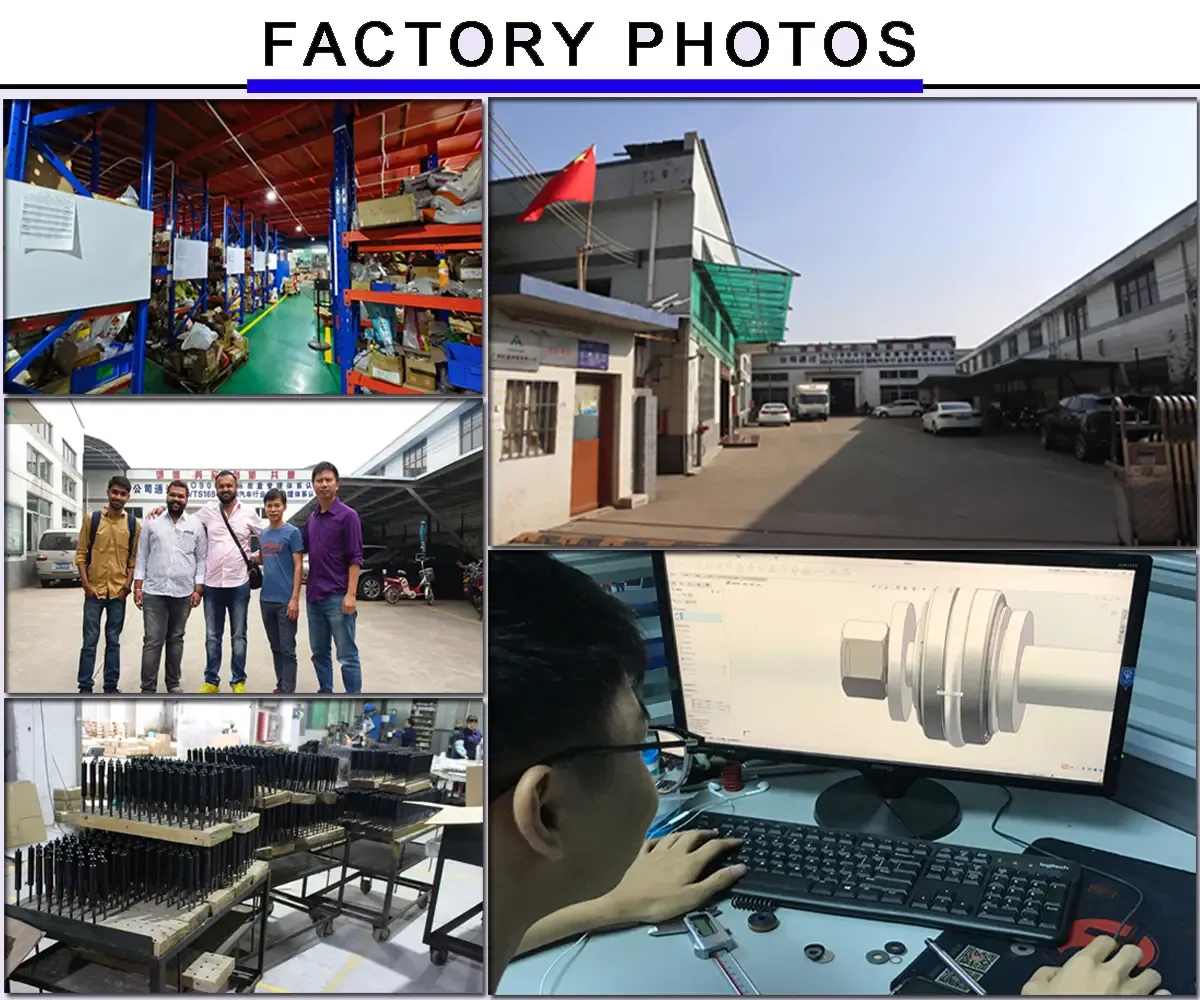
TieYing Factory Photos Show
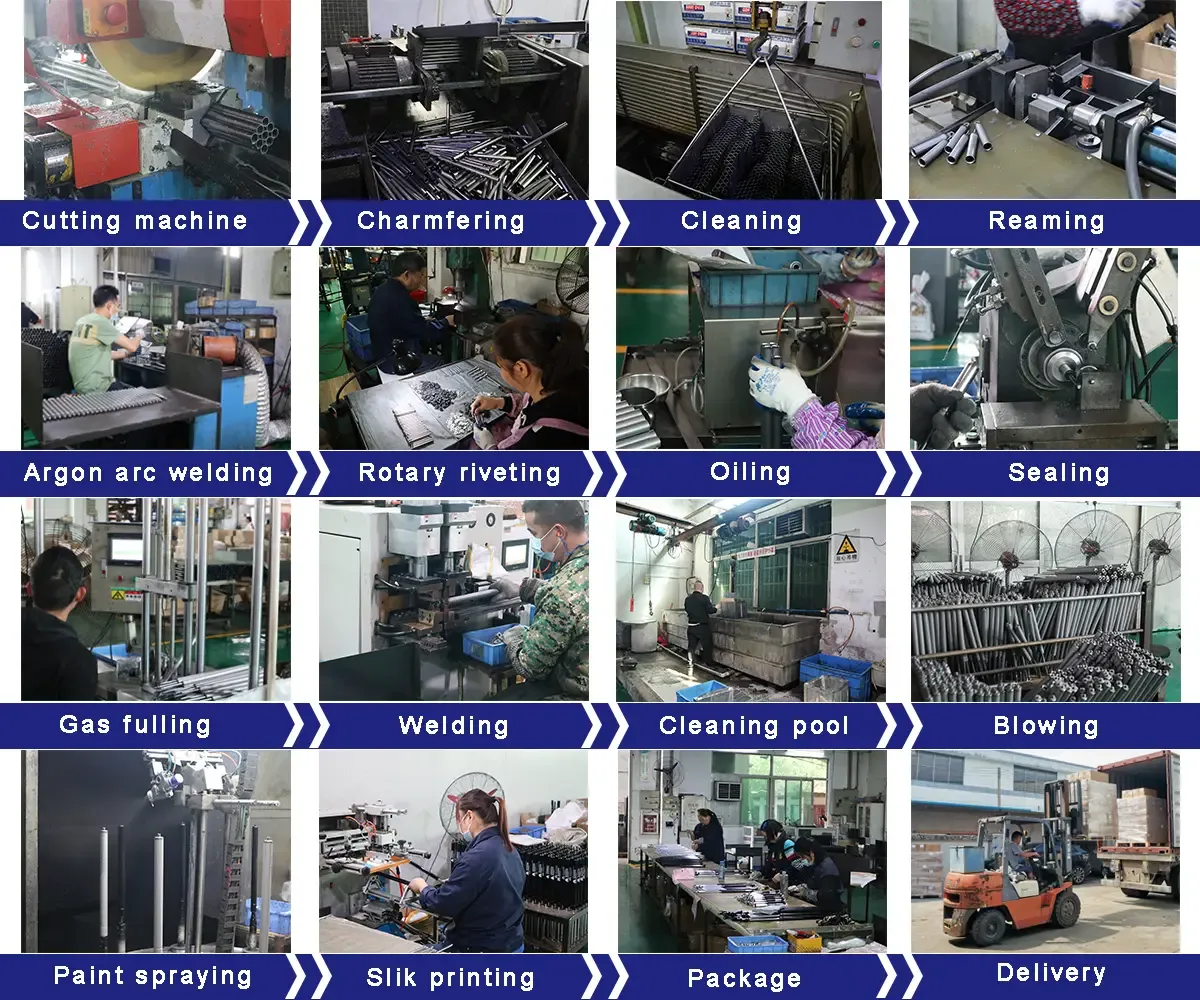
TieYing Factory Gas Springs Production Flow

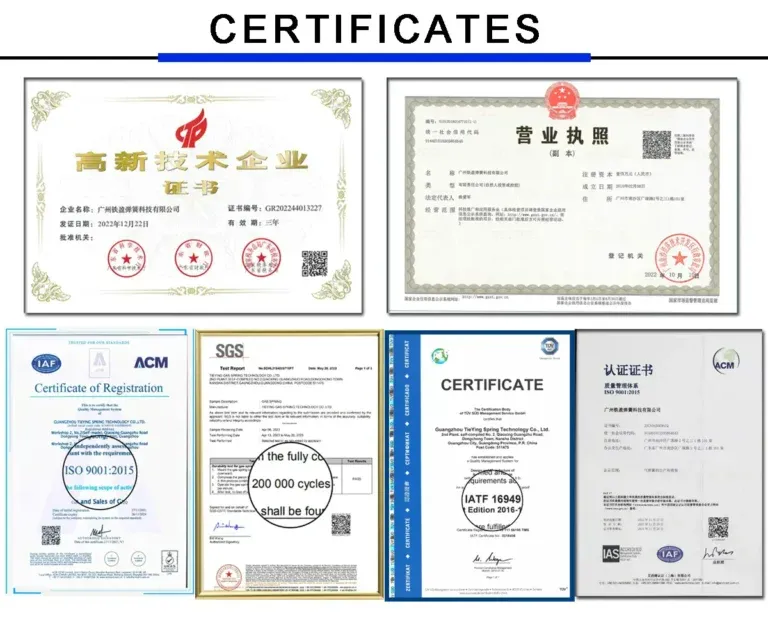
TieYing Factory Certifications & Quality Assurance
Factory Management System Certifications:
ISO 9001 – Quality Management System;IATF 16949 – Automotive Quality Management System
Product Testing & Compliance:
SGS – 200,000-Cycle Durability Test;RoHS – Restriction of Hazardous Substances
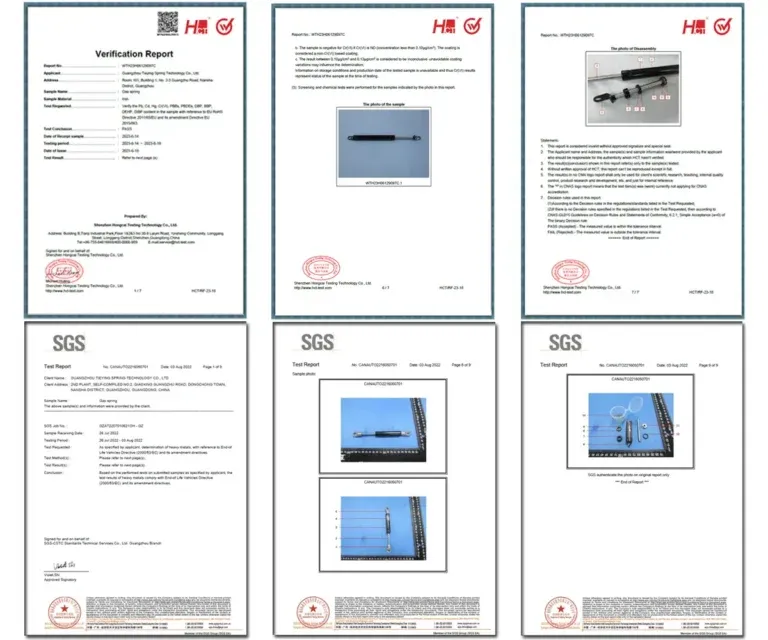
TieYing Factory Video Verified by SGS
Competitive Advantages of TieYing Gas Springs
| Item | TieYing Gas Springs | Standard Gas Springs (Other Supplier) |
|---|---|---|
| Certificate | SGS 200000 Cycles Durability Test, ROHS, T16949, IS09001 | Maybe just ISO9001 |
| Material | Top seamless steel (Full inspection by Professional testing equipment) | Maybe steel |
| Oil | Anti-wear hydraulic oil from Garmany | Maybe Semi-Synthetic |
| Piston Roughness | Up to Ra 0.696um | Maybe Ra 0.4um |
| Gas spring resistance | 100°C~-40°C | Maybe 60°C |
| Gas | 99.99% nitrogen | Maybe oxygen / Impure nitrogen |
| Uselife | 80,000-200,000 cycles with SGS test report | Maybe 50,000 cycles |
| Salt spray testing | Up to 96 hours | Maybe up to 12 hours |
| Inspection | All procedure sampling inspect, complete inspect before delivery | Maybe sampling inspection |
| Defective product | Re-produce new, If reach 10%, 100% items re-produce new | Maybe Repair |
Frequently Asked Questions (FAQ)
What are canopy gas struts used for?
Canopy gas struts lift, support and control the movement of outdoor canopy structures — patio awnings, retractable shades, truck canopies, marine bimini tops, market stalls and storefront canopies.
Can canopy gas struts be customized?
Yes. Force, stroke, extended length, end fittings, materials and finishes are all customizable. OEM production is available from customer drawings, samples or application requirements.
How do I choose the right force for a canopy?
Force selection depends on canopy weight, mounting geometry, opening angle and wind exposure. As a starting point, add a 10–25 % margin over the force needed to hold the canopy weight alone. Send us your canopy weight and mounting diagram and we calculate the exact Newton rating — not a guess.
How many gas struts does a canopy need?
One strut is usually enough for narrow, light canopies. For spans over 1.5 m, heavier frames or high wind exposure, install two struts symmetrically to balance the load and prevent frame twisting.
Can a gas strut hold a canopy open in wind?
A strut sized with a wind-load margin holds position in normal breeze. For strong-wind areas or awnings that must stay put, we recommend lockable gas springs, which mechanically lock the canopy in place and cannot be pushed closed by a gust.
What materials should I choose for outdoor use?
Painted or zinc-plated steel suits inland, low-humidity markets; nitro-carburized rods handle high humidity and frequent rain; stainless steel 304 or 316 is recommended for coastal and marine environments.
What temperature range do your canopy struts operate in?
−30 °C to +80 °C, with force output remaining stable across the range — important for canopies that face direct summer sun and winter cold.
Do you offer locking gas struts for retractable awnings?
Yes. Locking gas springs hold the awning at fixed positions along its travel, ideal for partial shade settings and wind protection.
Do you provide samples for testing?
Yes. Samples are available so your team can test fit, force and feel before production. Tell us the canopy weight and structure, and we will recommend and send the right configuration.
What is the difference between a canopy gas strut and a manual prop or lid stay?
Manual props and lid stays have fixed behavior. A gas strut uses compressed nitrogen for smoother, more controllable lift, adjustable force, damping, and optional locking — better suited to heavier, wider and wind-exposed canopy structures.
Ready to Source Canopy Gas Struts from a Trusted China Manufacturer?
Get wholesale pricing or start your custom project today. Our engineering team responds within 24 hours.